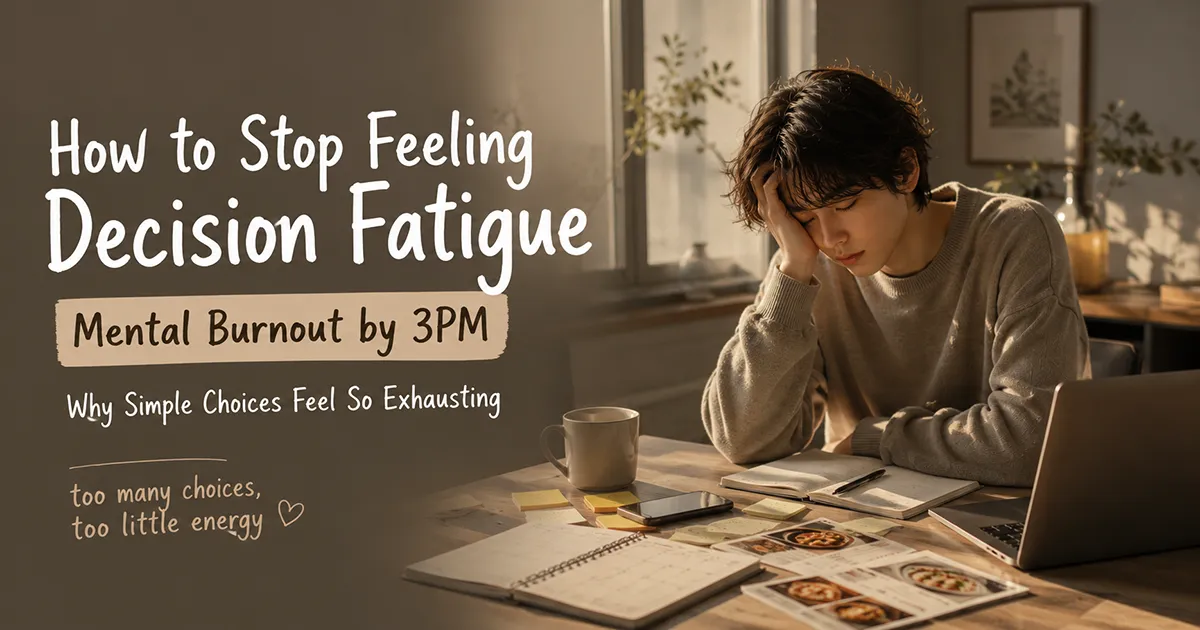
 By 3 PM, some people are mentally out of office.
Not asleep.
Not physically tired.
Just completely uninterested in making one more decision.
Someone casually asks:
“What do you want for dinner?”
And suddenly that feels like a deeply unreasonable request.
That’s usually decision fatigue.
Not because you’re bad at making choices.
Your brain has just been making too many of them since 8 AM.
Before lunch, you may have already decided:
- what to wear
- what to eat
- which email to answer first
- whether to reply now or later
- which tab to click next
- whether buying that completely unnecessary thing online is somehow urgent
Individually, these decisions feel tiny.
Collectively, they drain attention like background apps draining battery.
🧠 What Decision Fatigue Actually Is
Decision fatigue is what happens when your ability to make choices gets worse after repeated decision-making.
Nothing dramatic.
Just accumulated mental depletion.
Every decision costs a little attention.
Modern life is full of decisions your brain never asked for.
You are constantly choosing:
- what to watch
- what to ignore
- what to buy
- what deserves your attention for the next 12 seconds
The issue usually isn’t one major life decision.
It’s death by 200 tiny choices.
🚩 Signs You’re Probably Running Low on Decision Energy
Small Choices Start Feeling Annoyingly Difficult
Simple decisions start feeling heavier than they should.
Things like:
- what to cook
- which file to open
- whether to answer a message
- what show to start
Nothing here is objectively hard.
But suddenly everything feels like unnecessary admin.
So you delay.
Not because the decision is hard.
Because your brain is low on bandwidth.
You Start Defaulting to Whatever Is Easiest
This is where standards quietly disappear.
You stop optimizing.
Suddenly it becomes:
- same lunch again
- fine, whatever
- first option is good enough
- click accept all
Not because these are good choices.
Just low-resistance ones.
Easy becomes disproportionately appealing when your brain is tired.
Harmless Questions Become Mildly Irritating
Someone asks:
“Where do you want to eat?”
And your internal reaction is weirdly aggressive.
Not externally, hopefully.
But internally? Immediate irritation.
Decision fatigue makes harmless questions feel like surprise assignments.
- Saying “you pick” more than usual
- Avoiding low-stakes choices
- Ordering the same things repeatedly
- Irritability over small questions
- Mental fog by afternoon
- Impulse spending or snacking
📱 Modern Life Is Basically a Decision Factory
Modern life sounds convenient.
It is not mentally efficient.
Everything asks for a choice.
Examples:
- streaming platforms with 700 options
- unread notifications
- online shopping filters
- productivity apps recommending more productivity apps
- algorithm suggestions for things you did not know you needed
Choice sounds empowering until your brain is choosing all day.
“Too many options turn regular life into admin.”
This is why people spend 20 minutes choosing a show, then rewatch the same one anyway.
Not because they love routine.
Because choosing became the harder task.
Adult life is full of invisible decision taxes.
⏳ You Can Waste Huge Energy on Tiny Choices
One underrated symptom of decision fatigue:
You spend way too much energy on things that barely matter.
Example:
You open a delivery app.
Scroll for 11 minutes.
Compare restaurants like you’re making a mortgage decision.
Close the app without ordering anything.
This is not about food.
This is what cognitive depletion looks like in sweatpants.
Tiny decisions start absorbing way more energy than they deserve.
That’s usually a sign your brain is overloaded.
☕ How to Reduce Decision Fatigue
You cannot eliminate decisions.
But you can stop donating mental energy to unnecessary ones.
Automate Repetitive Choices
Not everything deserves daily analysis.
Things worth simplifying:
- breakfast
- grocery staples
- workout times
- basic outfits
- recurring tasks
A surprising amount of energy gets wasted reinventing Tuesday.
- Breakfast rotation
- Grocery basics
- Workout schedule
- Go-to outfits
- Default lunch options
Boring systems are underrated.
They protect attention.
Make Important Decisions Earlier
Your brain is usually sharper earlier in the day.
Use that window for:
- planning
- budgeting
- focused work
- difficult conversations
- anything requiring actual judgment
Saving your hardest choices for 9 PM is rarely a winning strategy.
Night brain is unreliable.
Night brain thinks buying a $94 water bottle is self-improvement.
Decide Faster on Low-Stakes Things
Not every decision deserves full internal debate.
If it is:
- low risk
- reversible
- emotionally unimportant
decide faster.
A lot of mental energy gets burned pretending tiny choices are high stakes.
😵 Why Decision Fatigue Feels More Emotional Than It Should
Decision fatigue is not just about focus.
It affects mood too.
When mentally depleted, people usually become:
- less patient
- more reactive
- less tolerant of uncertainty
This is why everything can start feeling slightly more irritating by late afternoon.
Not because your personality changed at 3 PM.
Your mental resources did.
A lot of people misread this as:
- laziness
- lack of discipline
- bad time management
Usually, it’s simpler.
Your brain is tired of evaluating things.
🧩 The Real Goal: Fewer Decisions That Don’t Matter
Most people do not need better discipline.
They need less decision clutter.
Modern life is full of choices pretending to be urgent.
Most are not.
The more you reduce low-value decisions, the more attention you keep for things that actually matter.
Not every decision deserves access to your brain.
Save your energy for the ones that do.
FAQ
Is decision fatigue real?
Why do simple decisions feel harder later in the day?
Can decision fatigue affect mood?
How do I reduce decision fatigue?
🧠 Conclusion
Decision fatigue explains a surprising amount of daily exhaustion.
Sometimes you are not tired from doing too much.
You are tired from deciding too much.
Modern life asks for an absurd number of tiny choices.
Your brain notices.
Reduce what does not need your attention.
Keep your energy for decisions that actually matter.