Some people walk into a room and instantly feel… noticeable.
Not because they’re the loudest. Not because they dominate every conversation. Not even because they’re unusually attractive.
There’s just something about them.
A grounded kind of presence. A calm energy. The feeling that they’re fully there.
That’s what people usually mean when they call someone charismatic.
And despite what social media or pop psychology might suggest, charisma is rarely about performance. It’s much more behavioral than people realize.
A lot of it comes down to small, repeatable habits—things you do every day that shape how people experience you.
If you’ve ever wondered about the daily habits that make you more charismatic, the answer is less “become more impressive” and more “become easier to feel around.”
🌱 1. Make Eye Contact Like You’re Actually Listening
Charismatic people don’t scan the room while you’re talking.
They make you feel temporarily important.
That sounds simple, but in practice, most people are distracted, mentally rehearsing what they’ll say next, or half-checking their phone.
Holding warm, natural eye contact signals presence.
Not intense staring. Not dominance theater.
Just attentiveness.
“Nothing feels more magnetic than someone who makes you feel fully seen.”
This is one of the most psychologically attractive behaviors because attention itself is emotionally rare now.
🧠 2. Pause Before You Speak
Fast responses can sometimes feel anxious.
Not always—but often.
Charismatic people usually have a tiny bit of space between stimulus and response. They don’t rush to fill silence like it’s an emergency.
That pause communicates something subtle:
I’m comfortable here.
It also makes your words feel more intentional.
This is a surprisingly powerful habit if you want to become more charismatic naturally.
Before answering a question, try waiting one extra second. It instantly changes your energy.
😌 3. Relax Your Face More Often
A lot of people accidentally walk around looking tense, rushed, or mildly irritated.
Not because they are. Because stress lives in the face.
Tight jaw. Pressed lips. Furrowed brows.
Charismatic people tend to look emotionally available.
That often just means softening your expression.
Not fake smiling constantly. Just looking less like you’re mentally replying to five emails.
Body language matters more than most people think.
🗣️ 4. Speak Slightly Slower Than You Normally Would
Not dramatically slower.
You’re not narrating a meditation app.
But a slightly slower speaking pace tends to signal calmness, confidence, and emotional regulation.
People unconsciously associate rushed speech with nervousness or approval-seeking.
Meanwhile, calm pacing feels grounded.
This is one of those habits charismatic people have that sounds trivial until you actually notice the difference.
🤝 5. Use People’s Names Naturally
Names create instant personalization.
Not in a weird sales-training way.
Just enough to make interactions feel less generic.
“Thanks, Mina.” “Good point, Daniel.”
It creates subtle warmth and memory.
People feel more connected to those who make them feel individually recognized.
📱 6. Put Your Phone Away During Conversations
This one is almost embarrassingly effective.
Because the bar is low.
Someone talking while glancing at notifications every 30 seconds feels fragmented.
Someone who fully puts their phone away feels unusually respectful.
And respect is deeply charismatic.
Not flashy. Not performative.
Just increasingly rare.
━━━━━━━━━━━━━━━
🧍 7. Practice Open Body Language
Closed-off posture creates social distance.
Arms folded tightly. Shoulders collapsed inward. Body angled away.
Meanwhile, open posture signals ease.
This doesn’t mean standing like a motivational speaker.
It means:
- uncrossing your arms
- keeping shoulders relaxed
- facing people directly
- not shrinking yourself physically
Your body often introduces you before your words do.
💬 8. Ask Better Follow-Up Questions
A lot of people know how to ask questions.
Fewer know how to ask interesting follow-ups.
Instead of: “How was your trip?”
Try: “What ended up being your favorite unexpected part?”
Instead of: “How’s work?”
Try: “What’s been mentally draining you lately?”
Charisma is often curiosity with emotional precision.
- ask fewer surface-level questions
- listen for emotional details
- follow threads people seem energized by
🫶 9. Validate Before You Advise
One of the fastest ways to kill connection:
Immediately solving someone’s problem.
People usually want understanding before solutions.
Try: “That sounds frustrating.” “I can see why that bothered you.”
Only then offer thoughts if needed.
This habit builds emotional safety—which quietly boosts your social presence.
😄 10. Laugh Generously, Not Performatively
Charismatic people are often easier to laugh around.
Not because they fake amusement.
But because they allow emotional warmth.
A small laugh. A genuine smile. A visible reaction.
This makes social interactions feel lighter.
People naturally gravitate toward those who feel emotionally responsive.
🧘 11. Get Comfortable Not Being the Center of Attention
Ironically, trying too hard to be interesting often makes you less magnetic.
There’s a difference between presence and performance.
Quiet confidence personality traits usually include:
- not forcing humor
- not over-explaining
- not needing every silence fixed
Confidence feels spacious.
Neediness feels noisy.
Do You Accidentally Drain Your Own Charisma?
0 / 4📚 12. Become Slightly More Observant
Charismatic people notice things.
A new haircut. A shift in mood. Someone getting quieter than usual.
Observation makes your interactions feel personalized.
And people remember that.
Not because you’re being strategic.
Because attentiveness feels intimate.
🌤️ 13. Regulate Your Energy Before Social Situations
A lot of “bad social skills” are actually dysregulated nervous systems.
You’re not awkward. You’re overstimulated.
Or under-slept. Or mentally scattered.
How to improve your social presence often starts before the conversation begins.
Take 2 minutes.
Breathe. Reset posture. Slow down physically.
Enter interactions like you’ve already arrived mentally.
🎯 14. Stop Over-Explaining Yourself
Over-explaining often comes from fear of being misunderstood or disliked.
So you add more context. More justification. More disclaimers.
And suddenly a simple statement becomes a TED Talk.
Charismatic people tend to trust their own communication.
They say what they mean, then leave space.
Not everything needs a footnote.
🌊 15. Make Other People Feel Slightly Better After Interacting With You
This is probably the entire thing.
Real charisma is less about how impressive you seem and more about emotional residue.
How do people feel after talking to you?
Lighter? More understood? More relaxed? More energized?
That matters more than having perfect jokes, flawless confidence, or extroverted energy.
“People rarely remember everything you said. They remember how their nervous system felt around you.”
⏳ 3-Second Summary
Daily habits that make you more charismatic usually aren’t dramatic.
They’re subtle patterns of emotional steadiness:
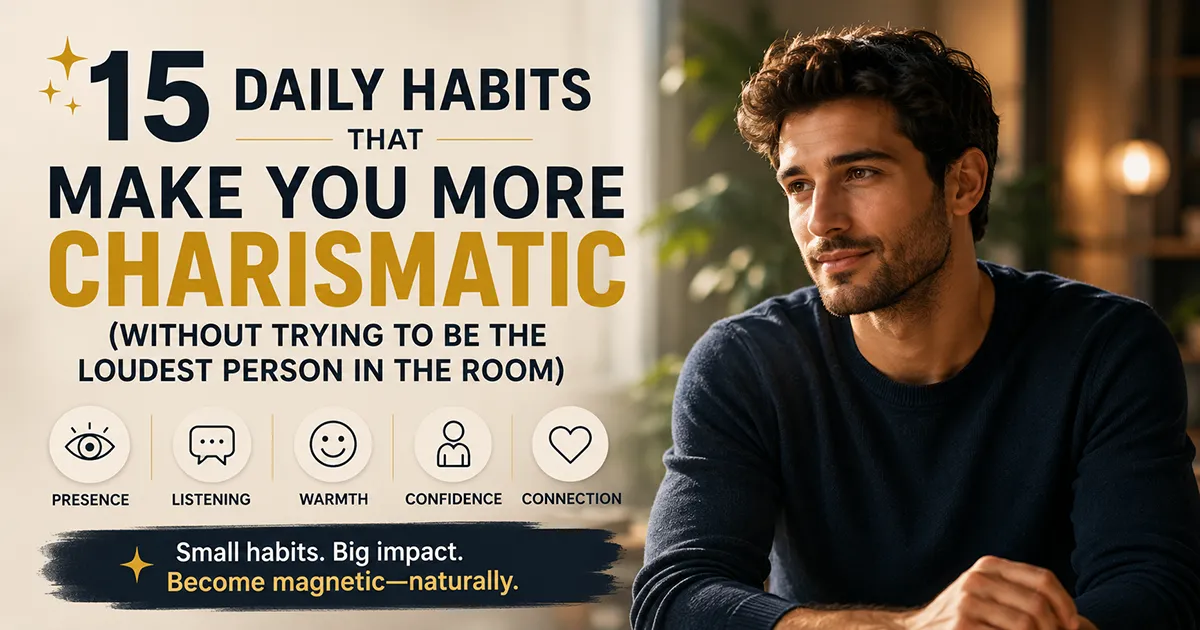
- presence
- warmth
- calm confidence
- attention
- restraint
- genuine curiosity
That’s it, mostly.
Not fake alpha behavior. Not social manipulation. Not pretending to be louder than you are.
FAQ
Can introverts be charismatic?
How long does it take to become more charismatic?
Is charisma something you’re born with?
What makes someone naturally likable?
✨ Conclusion: Charisma Is Usually Quiet
A lot of people think charisma belongs to naturally outgoing people.
But that’s mostly branding.
Real charisma is often quieter than that.
It looks like emotional steadiness. Comfort in your own body. Attention that feels generous instead of strategic.
The good news?
You don’t need a personality transplant.
Just better habits.
Small ones. Repeated often.
That’s usually how presence gets built.