There’s a specific kind of quiet that settles in your late 20s. You open your contacts, scroll past names you haven’t texted in two years, and feel this low, familiar ache — not quite grief, not quite guilt. Just the odd awareness that something shrank while you weren’t paying attention.
Your friend group got smaller. And you’re not entirely sure when it happened or whose fault it is. Mostly you’ve just been… living your life.
Here’s what nobody tells you: that’s not a sign something went wrong. It might actually mean something went right.
🧠 The Science Has a Name for This
Psychologists call it social network contraction — the gradual, mostly involuntary narrowing of your close social circle as you move through adulthood. Research by Robin Dunbar, the British anthropologist famous for “Dunbar’s Number,” suggests humans can meaningfully maintain around 150 relationships total, but only 5 truly close ones at any given time.
Those 5 slots? They take time. Consistent, repeated, unscheduled time — the kind that’s genuinely hard to manufacture once you’re past 25.
It’s not that you stopped caring about people. It’s that life stopped creating the conditions that made closeness effortless.
“Proximity and repetition are the two main ingredients of friendship. Adult life quietly removes both.”
In school, you were thrown together with the same people every day for years. You didn’t have to try — friendship just… accumulated. What feels like effort now used to be infrastructure.
📍 What Actually Causes the Drift
It’s rarely a fight. Rarely a betrayal. Most friendship loss in adulthood doesn’t have a dramatic story. It just has a last text that never got answered, and then another one, and then silence that became its own answer.
The triggers are almost always structural:
Graduation removes shared physical space overnight. One day you’re all at the same parties; the next, you’re in different cities applying for the same entry-level jobs.
Career shifts reorganize your schedule and your identity simultaneously. The person you were during that friendship sometimes doesn’t quite fit the person you’re becoming.
Relationships and kids introduce an entirely new social gravity. Your time, energy, and emotional bandwidth realign around a smaller orbit — not because you want to disappear, but because survival kind of requires it.
Therapy and personal growth — this one’s underrated. When you do real inner work, some relationships stop feeling safe, honest, or mutual. You outgrow certain dynamics the same way you outgrow certain behaviors.
None of these are betrayals. They’re just transitions. And transitions cost something.
😮💨 The Guilt Nobody Talks About
Here’s the part that actually hurts: most people carry quiet, low-grade shame about their shrinking social world. They compare themselves to people who seem to have big, loud, effortlessly close friend groups — the ones posting group Halloween costumes every year at 34 — and feel like they’re somehow failing at a basic human thing.
The people who look like they have it all socially figured out are usually just better at posting the moments they do have, not having more of them.
Social comparison around friendship is particularly brutal because it’s invisible. You can’t easily tell who’s genuinely thriving vs. who’s performing connection while eating dinner alone three nights a week. You just see the curated version. You feel the unfiltered version of your own life.
That gap will wreck you if you let it.
🔄 Growing Apart Isn’t the Same as Growing Wrong
There’s a version of this narrative that frames all friendship loss as failure — yours or theirs. But attachment research actually tells a different story.
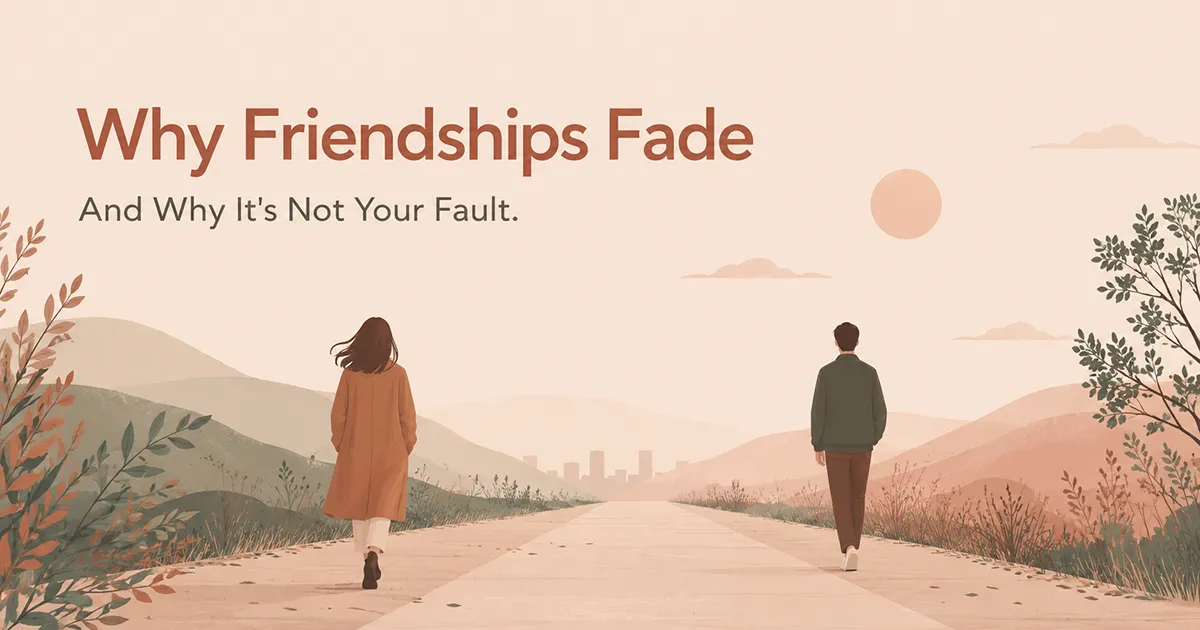
Psychologist Beverley Fehr’s work on friendship dissolution found that most close friendships don’t end because of conflict. They end because of divergence — people moving in different directions and the relationship not being able to sustain the distance without regular maintenance.
That’s not a moral failure. That’s physics.
- The last conversation felt normal — just infrequent
- There’s no specific thing that went wrong
- You’d still show up if they really needed you
- You follow each other’s lives from a comfortable distance
- You think of them warmly, just not urgently
Drift is quiet. It doesn’t require resolution. It doesn’t require a conversation or an apology or a dramatic ending. Sometimes people are just more present in a chapter of your life than in the whole book.
That’s allowed.
🪴 What a Smaller Circle Actually Signals
Here’s the reframe most adults need to hear: a shrinking friend group isn’t evidence of loneliness. It can actually be evidence of selectivity — and selectivity is a sign of self-awareness, not social failure.
As you get older, you start to notice what genuine closeness actually feels like. You stop tolerating relationships built on proximity, habit, or the fact that you were once young and confused in the same room together. You start needing friendships that can hold the full weight of who you are now — not just the version of you from 2014.
That’s a harder standard to meet. Fewer people will meet it. That’s exactly how it should work.
━━━━━━━━━━━━━━━
Research consistently shows that friendship quality has a far greater impact on wellbeing than friendship quantity. One person who genuinely knows you is worth more — psychologically, emotionally, neurologically — than fifteen acquaintances who like your Instagram posts.
The loneliness epidemic isn’t really about having fewer friends. It’s about having connections that don’t go deep enough to matter when things get hard.
🤝 The Friendships Worth Protecting
Not all drift is fine. Some of it is worth interrupting.
There’s a difference between friendships that naturally quieted down and friendships you’ve been neglecting out of avoidance, anxiety, or the low-level fear that too much time has passed to recover. The latter is worth examining.
Is This a Friendship Worth Reaching Back Out To?
0 / 5Adult friendship doesn’t require grand gestures. It mostly just requires someone being willing to go first.
💬 “I Just Don’t Know How to Make Friends Anymore”
This is one of the most googled things adults type alone at night. And it makes complete sense — the skills that built your early friendships (showing up to the same place repeatedly, having unstructured free time, being thrown into forced proximity) are just… not available to most adults.
Making friends as an adult requires something school never prepared you for: initiating without a reason. Suggesting plans without an event as an excuse. Texting someone just because you thought of them, not because a birthday reminded you they exist.
It feels vulnerable in a way that teenager-you never had to consciously navigate. And the fear of that vulnerability — of reaching out and being met with distance or indifference — keeps a lot of adults in social stagnation.
The answer isn’t a 5-step system. It’s just accepting that it’s going to feel a little awkward, and doing it anyway.
⏳ 3-Second Summary
Your friend group is supposed to get smaller. Depth replaces volume. Life transitions create drift that isn’t anyone’s fault. The guilt you feel is real but mostly misplaced — and one genuine connection beats ten performative ones every time.
🌱 You’re Not Falling Behind
If you’re reading this and feeling that particular quiet ache — the one that sounds like “everyone else has this figured out except me” — I want to offer you something that isn’t toxic positivity or empty reassurance:
You are not falling behind socially. You’re just in a part of life where connection requires more intention than it used to. That’s different from connection becoming impossible.
The friends who matter are either still here, waiting for you to stop assuming they’ve already moved on — or they’re people you haven’t quite met yet, also quietly wondering if anyone else finds this as genuinely hard as they do.
They do. You all do.
That’s the part nobody posts about.